
Dental Coaching vs Marketing Agency: The Growth Decision
Why the coaching model struggles to deliver sustainable practice growth and how marketing systems create compounding patient acquisition that coaching cannot replicate.
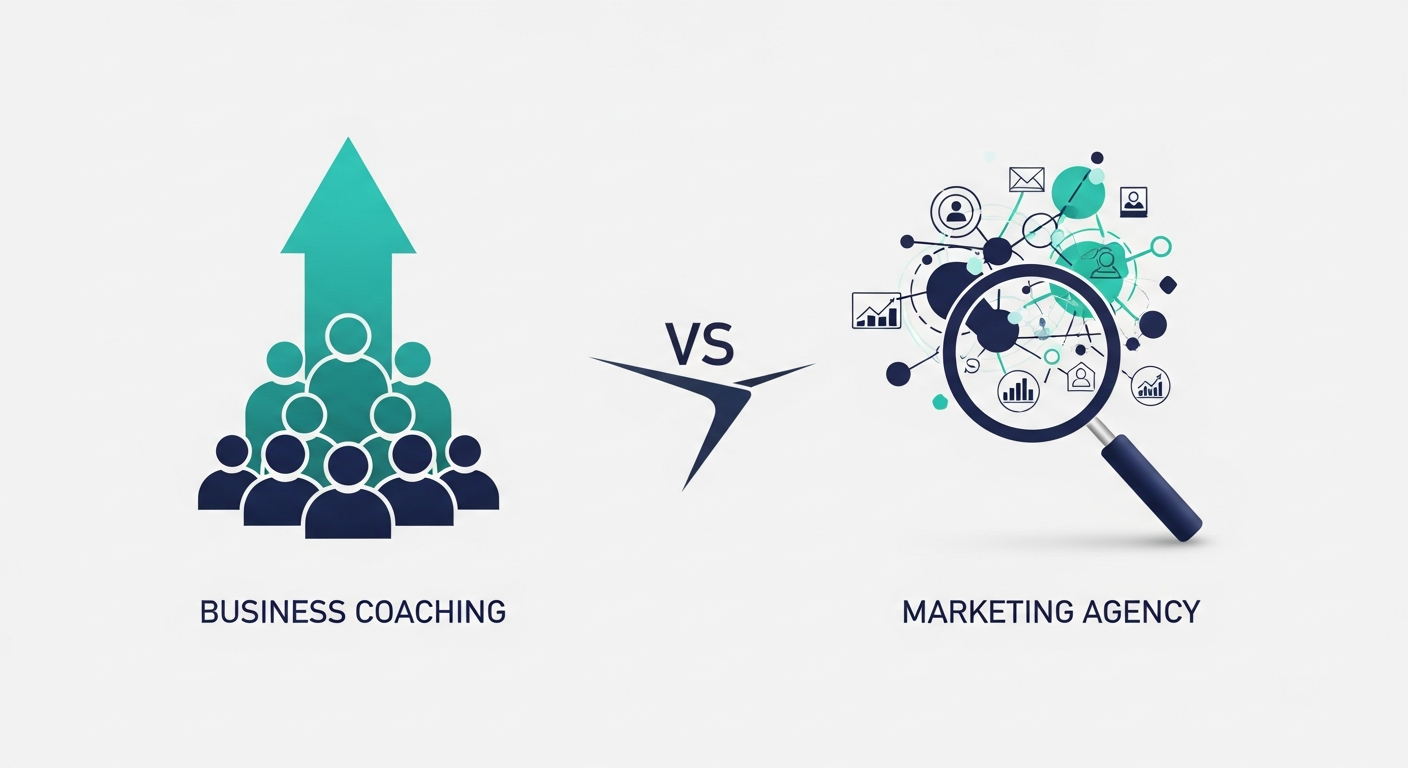
Dental coaching has become a massive industry. Thousands of practice owners pay monthly fees for accountability, guidance, and training. Yet many of these same practices struggle to grow.
Why? Because coaching addresses the wrong problem for most practices.
The Coaching Industry's Core Premise
Dental coaching rests on an appealing premise: practice owners lack business knowledge. If they just learned the right frameworks, attended the right seminars, and had someone holding them accountable, their practices would thrive.
There's truth here. Most dentists receive minimal business training in dental school. Running a practice involves skills—financial management, leadership, marketing, operations—that must be learned somewhere.
Coaching programs offer to fill this gap through:
- Monthly or quarterly strategy sessions
- Team training on customer service and case acceptance
- Financial benchmarking and analysis
- Peer networking with other practice owners
- Accountability for implementing changes
The appeal is obvious. Having an experienced advisor in your corner feels supportive and productive.
Where Coaching Breaks Down
The coaching model has a fundamental limitation: it can only improve what you already have.
Coaching optimizes internal operations. It makes your team more effective, your processes more efficient, your case presentation more compelling.
But coaching doesn't bring patients through the door.
Consider the math: if coaching helps you increase case acceptance from 50% to 70% (an excellent improvement), your production per patient increases significantly. But if you're only seeing 10 new patients per month, that operational improvement is applied to a small base.
Meanwhile, marketing that doubles your new patient flow from 10 to 20 per month has a larger impact—even without any operational improvements.
The Execution Gap Revisited
Coaching programs routinely advise practices on marketing. They'll tell you:
- "You need a better website"
- "You should be doing SEO"
- "You need more Google reviews"
- "Social media presence matters"
This advice is correct. But telling you to do something is very different from doing it.
Building a high-converting dental website requires:
- UX design expertise
- Conversion optimization knowledge
- Technical SEO implementation
- Content strategy and creation
- Development and ongoing maintenance
What coaching gives you: the knowledge that you need a better website.
What you still need: specialized skills to actually build it.
This pattern repeats across every marketing channel. Coaching can't execute marketing because marketing requires specialized capabilities that coaches don't have and practices can't develop in-house.
Coaching Pros and Cons
What Coaching Does Well
Fills knowledge gaps: Practice owners who lack basic business literacy genuinely benefit from structured education.
Improves team performance: Training on customer service, communication, and case presentation can meaningfully impact the patient experience.
Provides accountability: Having regular check-ins and someone reviewing your numbers can prevent procrastination and drift.
Creates peer connections: Learning from other practice owners facing similar challenges has real value.
Addresses internal dysfunction: Practices with team conflicts, process chaos, or leadership issues need coaching-style intervention.
Where Coaching Falls Short
Doesn't generate patients: No amount of coaching produces new patient leads. Full stop.
Depends entirely on your execution: Coaching value is limited by your ability to implement recommendations.
Creates recurring costs without compounding assets: Unlike marketing assets that build value over time, coaching produces knowledge that only matters if continuously applied.
Often delays real growth investments: Practices stuck in coaching cycles may postpone marketing investments they actually need.
ROI is difficult to measure: Attributing practice improvements to coaching (versus market conditions, new associates, or other factors) is nearly impossible.
Marketing Systems: A Different Approach
Marketing agencies operate on fundamentally different principles:
Execution, not advice: You're paying for work to be done, not ideas about work you should do.
Specialized expertise: Marketing skills take years to develop. Agencies bring that expertise on day one.
Measurable outcomes: Leads generated, cost per acquisition, and new patients booked are all trackable.
Assets that compound: Websites, SEO rankings, and content libraries continue producing value indefinitely.
Systems that scale: Once built, marketing systems work around the clock without proportional cost increases.
Marketing Pros and Cons
What Marketing Does Well:
- Generates new patient leads predictably
- Provides measurable ROI with clear attribution
- Builds compounding assets (website, rankings, content)
- Scales without proportional cost increases
- Works 24/7 once systems are established
Where Marketing Falls Short:
- Can't fix internal operational problems
- Requires real investment (not a cheap solution)
- Takes time to build momentum (especially SEO)
- Wasted if practice can't convert leads
Head-to-Head Comparison
| Factor | Dental Coaching | Marketing Agency | |--------|-----------------|------------------| | Primary function | Advise on operations | Execute patient acquisition | | New patient generation | None (indirect at best) | Direct and measurable | | Team required to implement | You and your staff | The agency | | Time to see results | Months to years | Weeks to months | | ROI measurement | Subjective/difficult | Objective/trackable | | Asset building | Knowledge only | Websites, rankings, campaigns | | Compounding value | Must be continuously applied | Builds over time | | Cost structure | Ongoing fees | Retainer + ad spend | | Typical monthly investment | $1,500 - $4,000 | $5,000 - $20,000 |
When to Choose Each
Coaching Makes Sense When:
- New patient flow is adequate but production per patient is low
- Team dysfunction is actively harming practice performance
- You genuinely lack basic business management knowledge
- Case acceptance is dramatically below industry benchmarks (below 40%)
- You're preparing for major transitions (partnerships, sales, retirement)
Marketing Makes Sense When:
- New patient numbers are below where you need them to be
- You're in a competitive market requiring visibility investment
- Your website doesn't convert or ranks poorly
- Growth goals require predictable patient acquisition
- You've relied on word-of-mouth and need scalable channels
- You're opening new locations
You Might Need Both When:
- Practice has both patient flow AND operational problems
- You're in a comprehensive turnaround situation
- Resources allow parallel investments
Frequently Asked Questions
My coach says we should do our own marketing. Is that realistic?
For most practices, no. Effective marketing requires specialized skills in SEO, paid advertising, web development, content creation, and marketing automation. These are professional disciplines that take years to master. Attempting DIY marketing based on coaching guidance usually produces poor results and wastes time.
If I invest in marketing, will I still need coaching?
Possibly, for specific operational issues. But many practices find that growth from marketing reveals which operational improvements actually matter. Often, issues that seemed important when growth was stagnant become irrelevant when patient flow increases.
How quickly should I see results from marketing versus coaching?
Marketing: Paid advertising can show leads within weeks. SEO takes 4-6 months for meaningful results. Coaching: Operational improvements can sometimes show up quickly in production reports, but sustained impact typically takes 12+ months.
Why do so many dentists stay in coaching programs for years?
Coaching relationships become comfortable. The regular meetings, the familiar advisor, the peer community—these create value beyond strict business ROI. Additionally, practices may not realize their growth problem is external (marketing) rather than internal (operations). They keep coaching hoping the next insight will breakthrough.
What's a reasonable budget for marketing versus coaching?
Marketing: 5-10% of revenue is a common guideline. A $1.5M practice might invest $7,500-$15,000 monthly. Coaching: $1,500-$4,000 monthly is typical for ongoing engagement. Both require commitment to be effective—underinvestment in either produces poor results.
Making the Right Choice
The coaching vs. marketing decision ultimately depends on diagnosis:
If your problem is internal—team issues, process chaos, clinical inefficiency, case acceptance—coaching addresses the right areas.
If your problem is external—not enough patients finding you, poor online presence, competitive disadvantage—marketing is the solution.
Most practices seeking growth have external problems. They need patients. Operational excellence without patient flow is like running an empty restaurant perfectly.
Explore how Brandside Digital builds marketing systems that deliver measurable growth. From SEO to websites to advertising, we execute the marketing that coaching programs can only describe.
Ready to discuss your practice's specific situation? Contact us.
Ready to grow your practice?
Let's discuss how these strategies can work for your practice specifically.
Book a Strategy Call